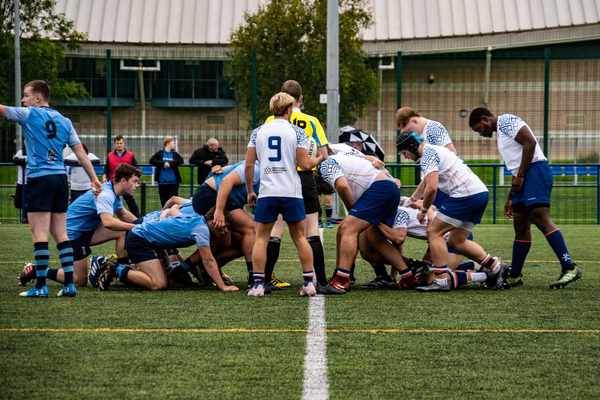
A rugby maul can look like a moving wall of jerseys, but the contest is more precise than it appears. Unlike a ruck, the ball stays off the ground while players from both teams bind together and compete for territory. Understanding rugby maul rules makes penalties, turnovers and try-line drives easier to follow.
When Does a Rugby Maul Form?
Under World Rugby Law 16, a maul forms in the field of play when a ball carrier and at least one player from each team are on their feet and bound together. The ball must be held off the ground. Two defenders holding an attacker upright do not create a maul until a teammate of the carrier also binds on.
Once formed, the group must move towards a try line. A maul is not simply any crowd surrounding a tackled player. If the ball is on the ground and players contest over it, the relevant laws may instead be those for a ruck. Our guide to rugby ruck rules explores that distinction.
How Rugby Mauls Work in Open Play
Imagine a winger caught upright near the touchline. A defender wraps the winger, and a supporting attacker binds onto the carrier. The maul is formed, even though only three players are involved. More teammates may join legally, while defenders try to stop the movement or win possession.
The attacking side wants to keep the ball secure and push forward. The defending side can resist and compete, but both teams must remain bound correctly and on their feet. The referee watches the ball, entry points and movement, not merely which pack is stronger.
Joining and the Offside Line
Every maul creates an offside line for each team through the hindmost foot of its participants, parallel to the try lines. An arriving player must approach from an onside position and bind onto the hindmost player in the maul. Entering from the side or attaching in front of that point can bring a penalty.
Players leaving a maul must retire behind their offside line before returning. A joining player’s head and shoulders must not be below hip height; this specific infringement brings a free-kick rather than a penalty. Correct binding helps keep the contest controlled.
Why Teams Use a Driving Maul
The classic driving maul starts from a lineout near the opposition’s try line. A jumper catches the throw, lands, and teammates bind around the carrier as opponents engage. If the pack gains momentum, the attackers may advance several metres without passing into open space.
That is not an automatic route to a try. The ball must remain playable, entry must be legal, and the carrier cannot slide or move backwards through the maul. Transferring possession within the group must comply with the laws; a player taking the ball from the carrier must maintain contact during that transfer. A long-arm transfer creating obstruction is illegal.
A useful viewing tip is to follow the rear feet rather than the mass of shoulders. You can often spot a side entry before the whistle, and the rear position shows where the scrum-half may wait. For the restart that creates this opportunity, see our explanation of rugby lineout rules.
What Happens When a Maul Stops?
Mauls may pause briefly, but cannot remain static indefinitely. If forward movement stops for more than five seconds while the ball is visibly being moved, the referee tells the team to use it. A stopped maul may restart towards a try line within five seconds; if it stops again with the ball visible and moving, the referee calls for use.
When the ball is available and the referee calls “use it”, the team has five seconds to play it. Failure brings a scrum. If the maul has stopped moving towards a try line for more than five seconds and the ball does not emerge, it can also end unsuccessfully with a scrum. The decision depends on ball availability.
Who Gets the Scrum?
Normally, an unsuccessful maul awards the scrum feed to the team that did not have possession when it began. That is why a defender holding up a runner can achieve a turnover without stripping the ball.
One exception matters: if a player catches an opponent’s kick directly in open play and a maul forms immediately, the catching team receives the scrum when that maul ends unsuccessfully. Possession when the maul formed is usually decisive.
Common Maul Penalties and Dangerous Actions
Not every failed maul is a penalty. A legal maul that becomes unplayable, or collapses without foul play, generally results in a scrum. A deliberate collapse is different: intentionally bringing the structure down is prohibited and penalised because of the risk to trapped players.
Other maul penalties arise when a player joins from the side, fails to bind, drags an opponent out, or obstructs the contest. Players cannot stand alongside pretending to be attached. Dangerous charges can also draw sanctions under wider rugby laws.
World Rugby’s June 2026 guidance addresses players who end up on the wrong side after the contest passes them. When they are no longer competing for the ball or space, they should leave rather than block its release or pull opponents. It clarifies enforcement rather than changing the law.
How a Maul Ends Legally
Play continues when the ball or its carrier leaves the maul, the ball reaches the ground, or it reaches or crosses the try line. The scrum-half might pass away, or the carrier might break free. If the ball becomes unplayable or the carrier goes down without making it available immediately, a scrum is normally awarded.
For spectators, ask three questions: Is the ball held up? Are players entering from behind their hindmost teammate? Is the group progressing or releasing the ball promptly? These clues explain most whistles.
Frequently Asked Questions
What is the difference between a maul and a ruck?
In a maul, the ball is held off the ground by a standing carrier with players from both sides bound on. In a ruck, the ball is on the ground between opposing players on their feet in contact over it.
Can defenders collapse a driving maul?
No. Intentionally collapsing a maul is illegal and brings a penalty. If it falls without foul play and cannot continue, the restart is generally a scrum.
How long does a team have after “use it”?
When the ball is available and the referee gives the call, it must be played within five seconds. Other stoppages have related but distinct requirements.
Can a maul score a try?
Yes. A legal maul can drive to the try line, where a player can score by grounding the ball correctly in the opposition’s in-goal area. The maul ends once the ball is on or over the try line.
Final Word
Good maul play is about controlled momentum, possession and legal support, not simply pushing hardest. Once you recognise how a maul forms, where players may join and why the ball must emerge, refereeing decisions make more sense. For another useful comparison, explore our guide to rugby scrum rules.