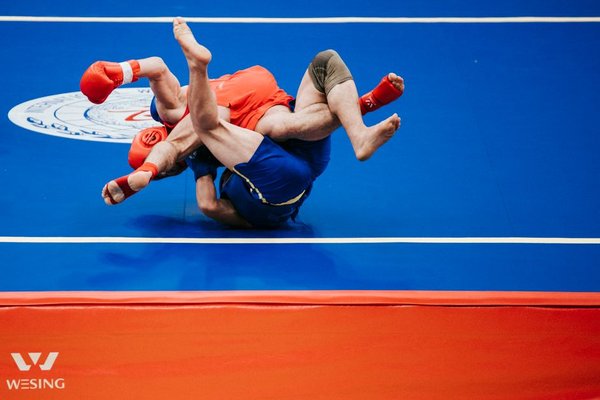
Watch two Olympic wrestling matches back to back and you may notice a striking difference. In one, athletes dive for ankles and finish takedowns around the knees. In the other, they fight for underhooks, body locks and powerful upper-body throws. That is the clearest way to understand freestyle vs Greco-Roman wrestling: freestyle permits leg attacks, while Greco-Roman prohibits holds below the waist and the active use of the legs against an opponent.
Both styles reward control, exposure and pins, but that single rule changes nearly every decision an athlete makes. Here is how to recognize the differences, understand the scoring and decide which discipline might suit you.
The defining difference: what you can attack
Under freestyle wrestling rules, competitors may grab an opponent’s legs, shoot for single-leg or double-leg takedowns, and use legal trips to bring someone to the mat. They can also attack the upper body, so freestyle offers a broad range of offensive choices.
Greco-Roman wrestling rules draw a firm boundary at the waist. Wrestlers cannot grab below it, trip an opponent or actively use their legs to complete or block a technique. Their attacks therefore concentrate on the arms, shoulders and torso. That does not mean they stand upright throughout the match: they still wrestle on the mat, defend positions and work for turns.
How the techniques and movement compare
Freestyle: level changes and leg attacks
A freestyle athlete must constantly protect against shots at the legs while searching for openings of their own. Changing levels, sprawling against a shot and chaining one takedown attempt into another are central skills. An opponent who lowers their stance may be setting up an ankle pick or a double-leg attack.
Upper-body throws remain legal in freestyle, too. Calling it simply “leg wrestling” overlooks the hand fighting, balance and counterattacks that make the style so varied.
Greco-Roman: clinches and upper-body control
Greco-Roman wrestlers spend more time fighting for inside arm position, underhooks and body-lock opportunities. Because they cannot grab a leg when an opponent shifts weight, they often need to create an opening through pressure, positioning and upper-body leverage. Arm throws and lifts are distinctive possibilities.
The restriction also changes defense. A move that uses a leg to block or trip an opponent may be routine in freestyle but illegal in Greco-Roman. Successful Greco-Roman athletes develop exceptional balance and awareness in close contact.
Scoring: similar points, different routes to them
Both Olympic wrestling styles award technical points for successful actions. A controlled takedown commonly earns two points. Exposing an opponent’s back toward the mat can also score two, while dynamic throws may earn four or five depending on how they are executed and where the opponent lands. Stepping out of bounds can give the opponent one point, although the precise circumstances matter.
A pin, officially called a fall, ends the match regardless of the score. If neither athlete secures a fall, accumulated points help determine the winner. A bout can also finish early through technical superiority: an eight-point lead in Greco-Roman or a ten-point lead in freestyle, once the scoring action has concluded.
This difference in the mercy-rule margin matters to spectators. A Greco-Roman wrestler who completes two major scoring sequences can finish a bout surprisingly quickly. In freestyle, repeated takedowns and turns can build a ten-point advantage.
Passivity and ground wrestling are not identical
Both styles penalize athletes who avoid meaningful engagement, but the procedures differ. In freestyle, a designated passive wrestler can face a 30-second activity period. If that wrestler fails to score during it, the opponent receives a point.
In Greco-Roman, passivity decisions can award the active wrestler a point on the first two passivity calls of the bout. The active wrestler may also choose a standing restart or an ordered ground position, known as par terre. Later passivity calls still offer a position choice without the automatic passivity point.
Par terre is important in both disciplines. From the top, wrestlers look to turn an opponent and expose the back. Greco-Roman’s restrictions on leg use continue on the ground, which is why its gut-wrench attacks and defensive positioning look different from freestyle leg-based control.
A practical example: the same opening, two outcomes
Imagine your opponent steps forward and leaves their lead leg exposed. In freestyle, you might lower your level, capture that leg and drive through to finish a takedown. If the first shot stalls, you could switch to another legal leg attack.
Now picture the same moment in Greco-Roman. Reaching down for that leg would violate the rules. Instead, you might use the forward movement to establish an underhook, move into a body lock or create the angle for an upper-body throw. You are solving the same balance problem with different tools.
For new athletes, a useful training exercise is to start from a neutral clinch and wrestle brief rounds under each ruleset, with a qualified coach supervising. Notice how your stance, distance and hand placement change when leg attacks disappear.
How the Olympic events compare
An Olympic wrestling comparison also involves divisions. Men’s freestyle, women’s freestyle and men’s Greco-Roman are contested at the Olympics; women’s Greco-Roman is not currently an Olympic event. United World Wrestling governs the international rules for these disciplines.
Senior international bouts generally comprise two three-minute periods with a short break. Wrestlers wear singlets and compete on circular mats. The shared setting can make the styles look similar at first glance, but watching where athletes place their hands quickly reveals which ruleset they are using.
Which wrestling style should a beginner try?
Freestyle may appeal to someone who enjoys changing levels, attacking legs and linking several takedown options together. Greco-Roman can appeal to someone drawn to clinch work, upper-body throws and sustained hand fighting. Neither style is automatically easier: each demands conditioning, timing, body control and disciplined defense.
Learning safe wrestling takedown techniques, positioning and how wrestling points work will help in either style. Athletes sometimes train in both, although competitive habits need adjusting when they change rulesets.
Frequently asked questions
Can you grab the legs in Greco-Roman wrestling?
No. Holds below the waist and active leg trips are prohibited. Leg attacks are permitted in freestyle, subject to its other safety and technique rules.
Are throws worth more points in Greco-Roman?
Not automatically. Both styles can award two, four or five points for different actions. High-value throws may be especially noticeable in Greco-Roman because upper-body attacks are central to its tactics.
Can both styles end with a pin?
Yes. A fall ends a bout in either discipline. Without a fall, the winner is determined under the scoring and victory rules, including possible technical superiority.
Is freestyle the same as American folkstyle wrestling?
No. Folkstyle, commonly practiced in American schools and colleges, has different scoring and emphasizes control and escapes in different ways. Freestyle is an international Olympic discipline with its own rules.
Final takeaway
The simplest distinction is also the most important: freestyle lets wrestlers attack the legs; Greco-Roman makes them work above the waist. From that rule flow the differences in stance, throws, defense and passivity strategy. Once you know what each athlete is allowed to grip, the action becomes easier to follow—and each style’s particular skill becomes easier to appreciate.